
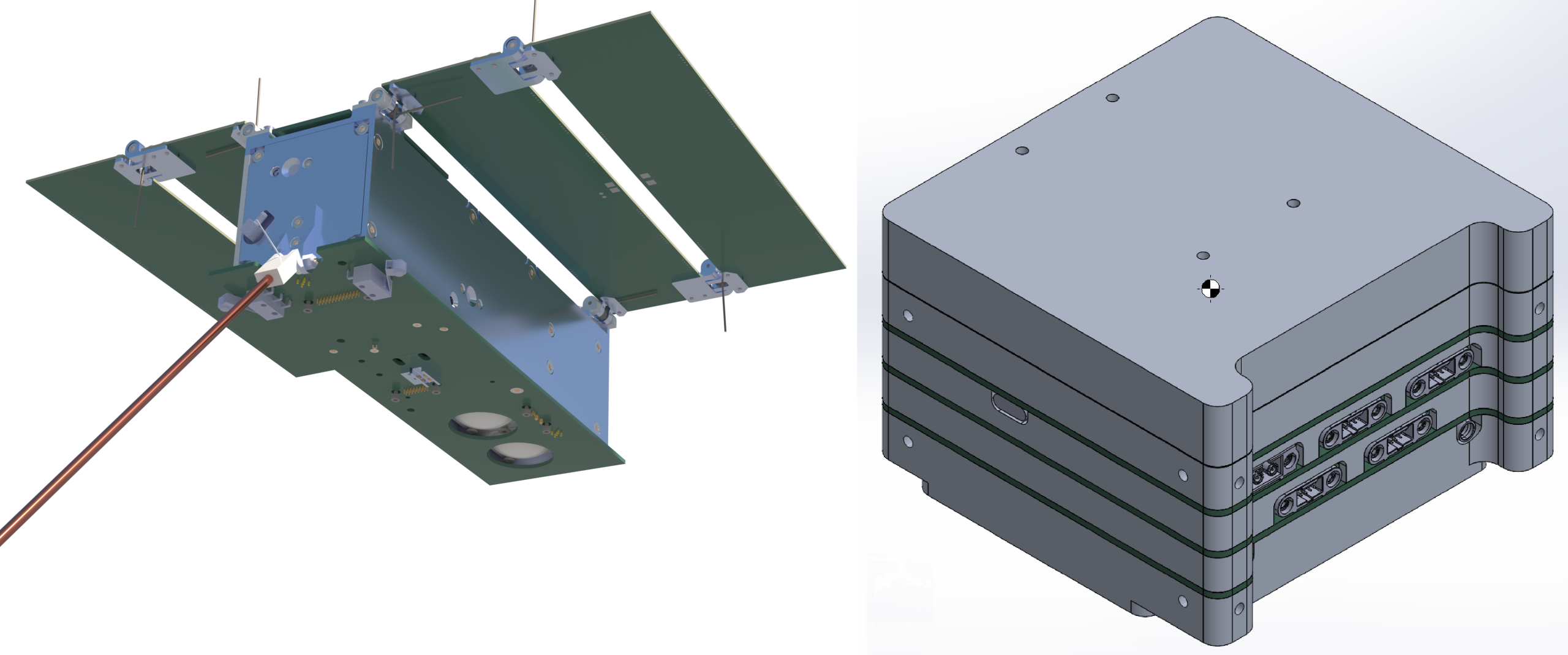
Due to the start of a new academic year and an increase in interest towards joining Student Satellite, this month we will be giving an introduction and recap regarding our two current ongoing projects: our SUTS satellite and our CubeSat Command Module. We will be taking a look at what they are, their mission objectives, the teams behind them, and how far along in development we currently are.
SUTS


But first, what is SUTS and what does it stand for? SUTS stands for the Strategic Upgrades Testing Satellite, and it is a 3-unit PocketQube, which means its total exterior dimensions are standardised at 50x50x178mm. Currently, SUTS is estimated to be delivered to our launch providers in the very beginning of 2028. The orbital mission for SUTS is expected to last at least 2 years, during which it will conduct operations as specified by its payloads.
Speaking of which, SUTS will have two main payloads, one of which is an encrypted optical communications payload developed by Golbriak Space OÜ and Skudo OÜ, and the second is a moon regolith simulant solar cell testing array developed by TalTech. The first will be tested for encrypted optical communication between SUTS and a ground station, and the second will be used to test the feasibility of using materials from the Moon for the production of solar panels.
The team behind SUTS consists of twenty to thirty members, the majority of whom are doing their bachelor’s and master’s degrees. Our SUTS project has the following four teams: Mechanics, ADCS (Attitude Determination and Control System), Software, and Electronics. The mechanics team is responsible for the assembly of the chassis of SUTS and all the main physical work. The ADCS team is responsible for ensuring SUTS is able to accurately position and orient itself in orbit. The software team is responsible for ensuring that all of the components, including the payloads, of SUTS can communicate and run as they are intended. Last but not least, the electronics team is responsible for ensuring that the satellite is able to function at all by connecting and running power to all of SUTS’ systems, along with producing all of the PCBs and boards that are used in SUTS.
Current SUTS Progress
Currently, the SUTS team is busy finalising the details to assemble the satellite’s Engineering Model, which itself is an assembly used for testing and emulating the satellite. After a very enlightening first assembly attempt in March, the team has been at work fixing the discovered shortcomings of the design. Right now, the team is mainly focusing on finalising all the electronic parts of the satellite. At the same time, they are also putting together a test plan for the upcoming environmental testing campaign.
CubeSat Command Module

The Command Module (CM for short) is a project that we are working on alongside SUTS. The intent behind the project is to create a Command Module that will be usable in a variety of different CubeSats for everyone, not just Student Satellite. This ensures that a standardised CM can be used for different missions instead of having to design and manufacture a new one each time.
Every CubeSat, regardless of its mission and its payload, will always have three main subsystems: the electrical power system, the command and data handling system, and the communications system. By building the Command Module, which consists of these ready-made subsystems, we can reduce the duplication of efforts in future missions and only focus on the changing factors that depend on the goals that the satellites aim to accomplish in their mission.
The Command Module is aimed to be future-proofed by integrating reconfigurable hardware, also known as field-programmable gate arrays (FPGAs) into its core. The FPGAs allow the user to reprogram the hardware at any given moment, allowing us to build a system that will truly be satellite-agnostic. Furthermore, we will be leveraging the FPGAs to run specialised machine learning algorithms that will allow the satellite to be more autonomous and respond to various anomalies in the system, ensuring that even missions aiming to be in the lunar orbit can use our Command Module, where the delay in communications require the satellites to generally operate independently without real-time user input.
The overall Command Module team consists of 25 to 30 members and is made up of the following subteams; Electronics, Mechanics, Mission Software, Flight software, FPGA, Radio Frequency, and additional system engineers. We have covered the work of all the mentioned teams in our previous blog posts in great detail, check them out!
Current Command Module progress
The CM team has finished the Preliminary Design Review (PDR), and will be consulting with their mentors and industry partners for their feedback and input regarding the current status of their product. The teams are hard at work, implementing the preliminary design, and collaborating with the ESTCube-3 team and TalTech to ensure the Command Module can be flown as soon as the end 2028 or the beginning of 2029.
Both SUTS and the Command Module are simultaneous projects being worked on by the Student Satellite Foundation and they both have their projected delivery date being the year of 2028. Our goal with SUTS and the CM is to support Estonia’s development as a space faring nation, and to also benefit and simplify space exploration globally with our CubeSat standardized Command Module.
If you wish to find out more about either of our projects, check out our previous technical blog posts which go more in depth about the different teams and aspects behind SUTS and the Command Module.
Leave a Reply